Cells have the ability to divide in order create new cells for growth or repair. The process, cell division, occurs in two stages. The first stage, mitosis, is when the nucleus divides into two parts, which each become a new nucleus. The two nuclei, called daughter nuclei, are identical copies of the original.Friday, September 16, 2011
Cell Division
Cells have the ability to divide in order create new cells for growth or repair. The process, cell division, occurs in two stages. The first stage, mitosis, is when the nucleus divides into two parts, which each become a new nucleus. The two nuclei, called daughter nuclei, are identical copies of the original.Wednesday, September 14, 2011

Reproduction is the creation of new life. All living things contain the parts needed for reproduction. In flowers, these produce male and female cells called gametes, which join to create new plants. The many specialized parts of flowers include petals, stamens (the male parts of the plants), and one or more carpels (the female parts). In most flowers, the petals are arranged around the reproductive organs. Before a plant blooms, it produces a bud, which eventually develops into a flower. It grows from the receptacle, which is the extended stalk tip. The buds are surrounded by the leaf-like sepals.
A flower's male reproductive parts are stamens. A stamen is made of an anther, a pod-like structure which contains pollen sacks, at the end of a stalk called a filament. When an anther opens, it releases grains of pollen, male reproductive cells. A female's reproductive part is the carpel or pistil. It is made up of the stigma, the top part, which has a sticky surface for pollen to stick to, the style, and the ovaries, each of which holds one or more tiny eggs. The tiny eggs are the female reproductive cells, which develop into seeds after they are fertilized.
Some flowers, like buttercups, have several carpels, while others, like poppies, have only one. Flowers that have male and female parts are described as hermaphrodite. Some plants have two types of flowers - pistillate flowers, which are female, and staminate flowers, which are male. These are called monoecious plants. Other plants, like holly, have only male or female flowers on them and require another plant for fertilization. These are dioecious plants.
Monday, September 12, 2011
Death in YOUR Garden!!!!
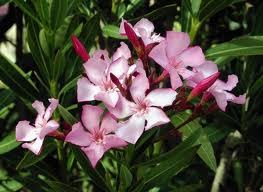
Oleander

Nerium oleander
Evergreen which grows from two to six feet high, with large clusters of red, pinkish or white flowers. This plant is extremely poisonous. Even the smoke from burning it is toxic. A single leaf can kill a human. It grows native in the Mediterranean region to Japan. It is often grown as a houseplant or patio tree in more temperate areas of North America.
Sweet pea
Lathyrus odoratus and other related species
Climbing vine with clustered, fragrant flowers in a variety of colors. Grows to 1-2 meters (about six feet six inches). If eaten in large quantities, it can be deadly. It grows in many gardens across North America.
Nutmeg
Myristica fragrans
Brown, spicy seed or brown powder. Harmless in small amounts, but more than 10 grams or 0.4 oz can cause acute poisoning or death.
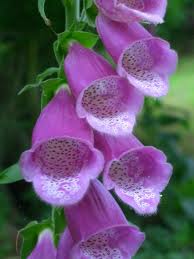
Purple foxglove
Digitalis purpurea
Biennial with tall flowering stalks. Has such nicknames as witch's gloves and dead man's bells. A nibble of a leaf on an upper stalk is enough to possibly cause death. However, it is also used to treat the heart.
Daphnes
Daphne mezereum
Deciduous shrub with purple or white flowers appearing in the spring. Scarlet or occasionally yellow berry-like fruits. The berries may be fatally poisonous, even if only a few are consumed.
Tuesday, April 26, 2011
Herbs


Makes popular teas and is commonly used for flavoring. Very good for treating headaches. Has a calming effect. Good for treating nausea, colds, fevers, influenza, colic, and vomiting.
Thursday, April 21, 2011
Wednesday, January 26, 2011
Let There be Light Waves!!!!!!!!!!!!!!!!
How does light move, you ask? Well, do you want the short or long answer? I'll give you the short. Light waves always move in straight lines. Have you ever been to Saskatchewan? I've been a couple times. If you have you'll have noticed that the place is so flat you can see the curvature of the earth. If you don't believe me then find out if you know anyone in Saskatchewan and get your parents to take you. Preferably driving. That way you'll see the highway, and that's one of the best places to veiw the curvature of the earth. Anyway, you can see things for miles because the light travels in a straight line.
Light always travels in a straight line. Imagine if it didn't! You wouldn't be able to see anything in front of you! That could get a little painful! :)
Monday, January 24, 2011
Filtering Light

To get different colors of light, we put our lights in colored tubes, or filters. Only certain colors can actually get through the glass, though, and that is why we have different colors. Some of the colors pass through, the rest are absorbed by the filter. The color we see, however, not only depends on the filter, but what the light is shining on.
If you put a red ball under a white light, you will see a red ball. If you put it under a red light, you will see a red ball. The red will probably be a slightly different shade, but it will still be red. Now, imagine if you put the same red ball under a green light. It will look like rather Christmasy, right? Wrong. The ball will be black. You see, the red ball absorbs the green light, so instead of looking like a really weird Christmas ornament, it rejects the black light, and that's what we see.
Here's one last interesting thing about light. The lights you have in your house produce more yellowish white light than the ones in stores. The lights in stores are usually fluoresent lights. This means that whatever is under the store lights looks a little different than in your house. This is a problem at paint stores, since not a lot of people realize that the sample they like looks different in their house!