Friday, April 13, 2012

An Elevator to Space


The idea of an elevator to space has been around since the 1960's. It comes from an idea for a satellite attached to Earth by a strong cable. Vehicles could travel to and from the satellite along the cable. Unfortunately, there are problems with this idea.

The cable could not be pulled behind a space vehicle as it took off, as it would slow it down. So it would have to be lowered from space. If a heavy cable is lowered from a satellite, the satellite's center of gravity changes. The satellite must go higher in order to adjust. A cable lowered in this fashion would have to be very long. A good design for this estimates the cable will be about 90,000 km long. This is long enough to circle the Earth. Twice.

The cable would also have to be strong. Steel wouldn't work. Not even diamond fibres. However, carbon nanotubes would work. A cable made of these would be light and thirty times stronger than steel. This cable would also be incredibly thin. The original design was for it to be 100 times thinner than a piece of paper. The entire cable could weigh 20,000 kg. The cable would likely be anchored offshore.

There are still problems. The cable could easily be damaged. And we actually don't know how to make a cable like the one required. The longest rope we've made out of nanotubes is only a few centimeters long. And the elevator can't exactly be tested. We can't only go part of the way up, then a little further. The cost of such a venture would be more than ten billion dollars. If we can work past these problems, however, we might soon be taking elevators to space.

Tuesday, April 10, 2012

Getting into Space


Rockets are how mankind has always traveled in space. However, they are also expensive. A rocket's energy equivalent is around 20% of that of the nuclear bomb that was dropped on Hiroshima. The rocket that sent the astronauts to the moon cost $500 million dollars to launch. NASA has determined that the space shuttle needs to be retired and is working on other ways to take man into space.

So how will we get into space in the future?

One possible way is by giving the shuttles a little boost. For example, flying them up to a certain height where they can fire off their rockets and take off into space. The problem with this idea is that, to do so, the shuttle would have to be light. And, with the fuel required to get into space, the shuttles are not light.

In Jules Verne's book, From the Earth to the Moon, the space vehicle is fired from a gun barrel three football fields long. Canadian scientist Gerald Bull tested this theory and shot a 16 inch projectile into space. It is possible that, in his later career as a weapons designer, he was working on creating a much larger version of this that could shoot objects into orbit. He was thought to be building this weapon for Saddam Hussein's Iraqi government, however, and was assassinated.

With the technologies being developed, who knows where we might go next?

Friday, April 6, 2012

Happy Easter, Everybody!!!!!!


Have you ever wondered why Easter's date changes?

It's called a "movable feast". A movable feast is a "holy day" which is not fixed according to the calendar but moves in response to the date of Easter. Such days include Good Friday, which is set two days before Easter.

Why does Easter move? The First Council of Nicaea, which was a council of bishops in 325 AD who were attempting to sort out issues with dates and such in Christianity, declared it to be so. The Christians had generally just asked their Jewish neighbors which days it was, since it was at the same time as Passover, one of their own festivals. However, some Christians felt that the Jewish calendar was unorganized and inaccurate.

The council decided to create their own, independent calculations to determine the date of Easter. The holiday was declared to be the first Sunday after the full moon following the Northern Hemisphere's vernal equinox, the beginning of Spring. Ecclesiastically, the vernal equinox is on March 21, although it actually occurs on March 20 most years. The date of Easter, therefore, varies between March 22 and April 25.

Happy Easter, everybody!!!!!!

Wednesday, April 4, 2012


Galileo discovered Saturn's rings in 1610, using his newly invented telescope. His telescope, however, wasn't clear enough for him to tell they were rings. He thought they were large moons, almost half the size of Saturn. However, when he observed Saturn later, the moons had disappeared. Later, an astronomer discovered that the "moons" were actually a flat disk, which had been turned edge on to Earth when Galileo observed it. Saturn's rings turn edge-on to Earth every fourteen years. After that, another astronomer discovered that the flat disk was actually rings around the planet.

The rings of Saturn start about 6,000 kilometers from the planet and extend 480,000 kilometers. They are wide, but very thin, about a kilometer thick on average. They seem to be made up mostly of small particles of ice and rock. There are seven rings altogether.

Other planets also have rings. A spacecraft, sent to Jupiter, flew right through them with no one noticing anything at the time. The rings are as wide as Saturn's, but darker. Neptune and Uranus also have thin rings.

Eventually, the rings of Saturn will dim. Micrometeorites will smash the ice crystals in the rings. Left will be fragments of black rock and metal and dirty ice. This process will wear away at the rings. The rings will gradually grow darker and thinner until there is nothing left. Enjoy them while you can.

Wednesday, March 28, 2012


In 2006, Pluto was officially declared not to be a planet anymore. It was, instead, announced a dwarf planet. What caused this decision?

Pluto is tiny - scientists think it's about 2,300 kilometers in diameter. There are several moons in our solar system larger than the planet. Another feature that caused it to be demoted is its orbit. The planet's orbit cuts through that of Neptune's.

Scientists began to find objects beyond Pluto. They were mostly smaller than Pluto, and have been named Kuiper Belt Objects (KBOS). There is estimated to be at least 70,000 that are over 100 kilometers across. In 2000, astronomers started to find objects closer to Pluto's size. Then they found Eris. Eris was larger than Pluto. It cuts inside Pluto's orbit when closest to the sun and, when furthest, is twice as far as Pluto's orbit. It takes more than 550 years to circle the sun.

All these discoveries meant that, if Pluto was to be called a planet, then Eris should be called one too, as well as many KBOS. Scientists, in 2006, voted on the definition of a planet. A planet had to be a sphere. A planet had to be in orbit around a star. And a planet couldn't be with a group of other objects, orbiting peacefully. That was the final blow for Pluto. It is now classified as a dwarf planet.

Monday, March 26, 2012

Space Junk


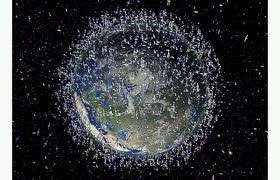
Space is full of junk.

When the astronauts went to the moon, they left trash there. Very expensive trash. The amount of trash in space is becoming a problem. And with more satellites going up every year, the amount is growing quickly. It is estimated that there is nearly 2 million kilograms of space junk in low Earth orbit. Much of this is being tracked as it orbits the earth. There are about 10,000 objects that are about the size of a grapefruit or larger.

If a piece that large were to hit a satellite or space station, it could do some serious damage. If an object a centimeter or larger, moving at 40,000 kilometers an hour, were to hit something, it would be the equivalent of throwing a bowling ball at speeds of 500 kilometers an hour at a human being. The Space Shuttle has returned with large chips in its windshield (I don't think there are winds in space, but you know what I mean) that came from colliding with a speck. Impacts from space junk have been thought to disable two satellites.

So what can we do? Most of this junk will eventually fall to Earth. However, this can take a while, and it's a hazard to astronauts. There is a 1 in 91 chance that an astronaut could be hit with a piece big enough to penetrate their suit. The astronaut would be very lucky to survive. As if their jobs weren't already full of dangers.

Monday, March 5, 2012

Black Holes


Black holes are regions of space that have such massive gravitational pull that not even light can escape. No one has ever directly seen a black hole. There is thought to be one in the center of our galaxy, 40,000 times larger than the sun.

How is a black hole formed? There are many theories. The most common is that when a big star, about three times the size of the sun, reaches the end of its life, its stability cracks under its own gravity. The radius of the star shrinks and it starts to devour everything that's close enough. We cannot actually see a black hole. However, we can see the area of space affected by it. It is the event horizon, where there is no light. It is called a horizon because, like a horizon on our own planet, we cannot see beyond it.

If you enter an event horizon of a black hole, you will start to accelerate under the influence of gravity. You may start to orbit around the black hole, bumping into other pieces of matter. The jostling might throw you away from the black hole, or it might knock you into it. It won't go black as you go over the event horizon. You'll be able to see what's outside of the event horizon. The light everywhere will appear strange and distorted by the gravity.

If you look down, you'll see the singularity, which is a point where all physical laws have, basically, become indistinguishable from each other. At this point, you will begin to stretch and very quickly loose interest in what is going on around you. Fortunately, this should be fairly quick. Predictions about the inside of a black hole can be made, but it eventually gets too weird for science to describe. And a visit to a black hole is highly inadvisable.