Monday, March 26, 2012

Space Junk


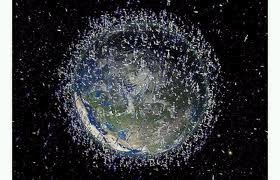
Space is full of junk.

When the astronauts went to the moon, they left trash there. Very expensive trash. The amount of trash in space is becoming a problem. And with more satellites going up every year, the amount is growing quickly. It is estimated that there is nearly 2 million kilograms of space junk in low Earth orbit. Much of this is being tracked as it orbits the earth. There are about 10,000 objects that are about the size of a grapefruit or larger.

If a piece that large were to hit a satellite or space station, it could do some serious damage. If an object a centimeter or larger, moving at 40,000 kilometers an hour, were to hit something, it would be the equivalent of throwing a bowling ball at speeds of 500 kilometers an hour at a human being. The Space Shuttle has returned with large chips in its windshield (I don't think there are winds in space, but you know what I mean) that came from colliding with a speck. Impacts from space junk have been thought to disable two satellites.

So what can we do? Most of this junk will eventually fall to Earth. However, this can take a while, and it's a hazard to astronauts. There is a 1 in 91 chance that an astronaut could be hit with a piece big enough to penetrate their suit. The astronaut would be very lucky to survive. As if their jobs weren't already full of dangers.

Monday, March 5, 2012

Black Holes


Black holes are regions of space that have such massive gravitational pull that not even light can escape. No one has ever directly seen a black hole. There is thought to be one in the center of our galaxy, 40,000 times larger than the sun.

How is a black hole formed? There are many theories. The most common is that when a big star, about three times the size of the sun, reaches the end of its life, its stability cracks under its own gravity. The radius of the star shrinks and it starts to devour everything that's close enough. We cannot actually see a black hole. However, we can see the area of space affected by it. It is the event horizon, where there is no light. It is called a horizon because, like a horizon on our own planet, we cannot see beyond it.

If you enter an event horizon of a black hole, you will start to accelerate under the influence of gravity. You may start to orbit around the black hole, bumping into other pieces of matter. The jostling might throw you away from the black hole, or it might knock you into it. It won't go black as you go over the event horizon. You'll be able to see what's outside of the event horizon. The light everywhere will appear strange and distorted by the gravity.

If you look down, you'll see the singularity, which is a point where all physical laws have, basically, become indistinguishable from each other. At this point, you will begin to stretch and very quickly loose interest in what is going on around you. Fortunately, this should be fairly quick. Predictions about the inside of a black hole can be made, but it eventually gets too weird for science to describe. And a visit to a black hole is highly inadvisable.

Friday, February 17, 2012

Even More Poisonous Plants...

Common Snowberry


Symphoricarpos albus and related spp.

Snowberries are sometimes grown as ornamental shrubs in North America and Europe. One child, after eating three berries, experienced mild sedation, vomiting, and slight dizziness. Others have died from eating them. In several indigenous languages, they are known as ghost berries or corpse berries.

Calla Lilies


Zantedeschia aethiopica and related spp.

When ingested, this attractive flower causes intense burning of the mouth and throat. however, it is seldom fatal. They are grown as houseplants in many places, although they are native to South America.

Jack in the Pulpit


Grows in much of Eastern North America. The plant causes salivation, nausea, and vomiting. Very rarely, it causes irregular heart beat, fits, coma, and death. Fortunately, the plant burns when it is swallowed, so a fatal dose is rare.

Buttercups


Ranunculus spp. and related genera

Attractive yellow flowers. They are found throughout North America. The fresh plants can cause painful blistering of the skin and irritate the mouth. However, they taste horrible, so it is rare that they are eaten in quantity. However, a fatal dose is not impossible.

Thursday, February 16, 2012

More Poisonous Plants...

Black Hellebore

Helleborus niger and related spp.

An herbaceous perennial, with the flowers blooming in winter or spring. Poisoning is rare, but can be fatal. Symptoms of poisoning involve cramps, nausea, visual disturbances, and vomiting.

Larkspur and Delphinium


Consolida ajacis, Delphinium spp.

These plants grow in many gardens. Their poison is similar to that of aconite, a highly poisonous plant. The amount of poison in these plants depends on the age of the plant and the species, but a fatal dose is not impossible.

Hemlock


Conium maculatum

Carrot like plants. The root can be mistaken for carrots and the leaves for parsley. The plant has an unpleasant taste and smell, which is fortunate, since it is deadly poison. It was used to kill Socrates and is said to be a very humane way to die. Initially, those who eat it will feel stimulated, then fall into severe depression of the nervous system, became paralyzed, and die if not helped.

Thursday, February 9, 2012


Energy plays an important role in chemical reactions. A chemical reaction that stores energy is called an endothermic reaction. In photosynthesis, solar energy is stored in the sugar molecules. Most endothermic reactions store energy in the form of heat. Another endothermic reaction is putting a chemical ice pack on an injury. The chemicals inside are stored separately, but when mixed feel cool against the skin.


Exothermic reactions are the opposite of endothermic. These release energy. Burning something is an exothermic reaction. So is the reaction that digests your food. As food molecules are broken down, energy is released that the body uses to function.

Wednesday, February 8, 2012

Catalysts


A catalyst is something added to a chemical reaction in order to speed it up. The reactants have to reach a certain energy level before they can react, and a catalyst can speed up the process. It reduces the amount of energy needed for the reaction. For example, chlorophyll is a catalyst that speeds up photosynthesis. Enzymes are also catalysts, found in living cells. They are used in reactions that are involved in digestion, cell construction and reproduction. If we did not have enzymes, we would be unable to produce glucose at the speed our body needs it, so these are essential to life.


What do you add if you want to slow a reaction down? You use a negative catalyst. If a chemical reaction, such as food spoiling, is occurring, it can be slowed down, by things like fruit freshener. Negative catalysts, or inhibitors, help keep the reactants apart, or bond with other reactants so the reaction will not take place.

Monday, February 6, 2012

Reacting

Chemical reactions occur when two or more elements combine and form a new substance or when a substance is broken down into its seperate elements. Chemical reactions are everywhere. Bread rising is a chemical reaction. Fireworks going off is a chemical reaction. Fire burning is (well, I suppose you've already guessed this) a chemical reaction.

Reactions often change heat. An exothermic reaction, for example, is one where the product is hotter than what went into it. If the product is cooler than its reactants, then its called an enothermic reaction. There are many different sorts of chemical reactions. If an element combines with oxygen, the reaction is an oxidation reaction. If oxygen is removed from a substance, it is called a reduction reaction. If elements other than oxygen combine, then the substance formed is called a composition reaction. If a substance is broken down, it's called a decomposition reaction. Some reactions, like rust, occur very slowly. Others happen quickly, like fireworks.

In order for a reaction to take place, the reactants must all be in contact with each other. The size also matters. A cube of iron will rust more slowly than a sheet with the same amount of material, because the thin sheet has more surface area and the oxygen in the air can react with more iron particles. The concentration of the reactants also speeds up the reaction. The more molecules of each reactant, the more likely they are to come in contact and react. Heat can also increase the speed of the reaction, because it causes the heat causes the molecules to move more quickly. Adding a catalyst can also help. A catalyst speeds up the reaction, but is not used up.