Our planet is the only one known to be able to support life. But what if we had to leave, make a new home on another planet? Our two closest neighbors are Venus and Mars. They are about the right distance from the sun to house life. Venus, unfortunately, has poisonous gases in its atmosphere, making it a poor choice for a home. However, Mars does not. Would we be able to turn it into a home, if we had to?
To make the red planet green, we would need an atmosphere that could support life. There are large amounts of carbon dioxide in Mars's polar ice caps. If we could raise the temperature of the planet, it would start to melt. Hey, we've managed to do it here - why not on Mars, too? If the temperature of Mars went up, water in the planet would start to melt. We would need this water, since the price of shipping would be huge if we wanted it from Earth.
Another problem is the amount of nitrogen in the atmosphere. Earth has 70%. Mars has 3%. Nitrogen is essential to life. We would have to bring nitrogen in. This could be done by taking rockets out to the asteroid belt and selecting certain ones with plenty of nitrogen, then driving them back. This, however, turns an already incredibly ambitious project into a near impossibility. In the best case scenario, if everything went well, after this was done, it would take a hundred years to complete. Growing plants on Mars, which would be necessary, is made difficult by radiation.
If everything went smoothly and we could grow plants, the oxygen levels might be enough to just barely survive on Mars in a thousand years. Then there would have to be volunteers who would move to Mars. But, if we ever actually could terraform Mars, we would probably find a way to clean up Earth, which would be easier anyhow.
Showing posts with label Space. Show all posts
Friday, April 27, 2012
We can't explore space in the same way we can our own world. If we want to explore a certain part of our own world, we go ourselves. But we can't travel in space, at least, not very far. So how do we explore the stars? One of the earliest tools for studying the stars was the astrolabe. It works in in much the same way as a protractor in geometry, measuring angles. It was used to calculate the difference between the stars and planets.
Nowadays, we have more advanced tools. These instruments measure the waves of radiation given off by objects in space. There is a spectrum to measure how much various objects give off. At the right end of the spectrum, we have gamma rays, X-rays, and other rays. At the other end are radio and infrared rays. We can see only a very tiny amount of these rays, the ultraviolet rays, which make up the rainbow.
Radio telescopes pick up radio waves. The telescopes pick up waves, then amplify them and send them to a computer, which processes the information. By studying these waves, scientists can learn about far away galaxies and planets that are far, far away.
Infrared telescopes pick up on the waves that we feel as heat. We can't see the signals, but can sense them instantly. These allow astronomers to guess at the temperature of a certain object. Some snake have eyes that locate prey by detecting sources of heat.
Ultraviolet telescopes need to be placed outside of Earth's atmosphere in order to work, since our atmosphere blocks out most ultraviolet rays. They pick up on the ultraviolet rays. New stars and many of the most active objects in the universe emit these rays.
We have many inventions with which to explore the solar system. And, in time, who knows? Maybe we will be able to look for ourselves.
Nowadays, we have more advanced tools. These instruments measure the waves of radiation given off by objects in space. There is a spectrum to measure how much various objects give off. At the right end of the spectrum, we have gamma rays, X-rays, and other rays. At the other end are radio and infrared rays. We can see only a very tiny amount of these rays, the ultraviolet rays, which make up the rainbow.
Radio telescopes pick up radio waves. The telescopes pick up waves, then amplify them and send them to a computer, which processes the information. By studying these waves, scientists can learn about far away galaxies and planets that are far, far away.
Infrared telescopes pick up on the waves that we feel as heat. We can't see the signals, but can sense them instantly. These allow astronomers to guess at the temperature of a certain object. Some snake have eyes that locate prey by detecting sources of heat.
Ultraviolet telescopes need to be placed outside of Earth's atmosphere in order to work, since our atmosphere blocks out most ultraviolet rays. They pick up on the ultraviolet rays. New stars and many of the most active objects in the universe emit these rays.
We have many inventions with which to explore the solar system. And, in time, who knows? Maybe we will be able to look for ourselves.
Tuesday, April 10, 2012
Getting into Space

Rockets are how mankind has always traveled in space. However, they are also expensive. A rocket's energy equivalent is around 20% of that of the nuclear bomb that was dropped on Hiroshima. The rocket that sent the astronauts to the moon cost $500 million dollars to launch. NASA has determined that the space shuttle needs to be retired and is working on other ways to take man into space.
So how will we get into space in the future?
One possible way is by giving the shuttles a little boost. For example, flying them up to a certain height where they can fire off their rockets and take off into space. The problem with this idea is that, to do so, the shuttle would have to be light. And, with the fuel required to get into space, the shuttles are not light.
In Jules Verne's book, From the Earth to the Moon, the space vehicle is fired from a gun barrel three football fields long. Canadian scientist Gerald Bull tested this theory and shot a 16 inch projectile into space. It is possible that, in his later career as a weapons designer, he was working on creating a much larger version of this that could shoot objects into orbit. He was thought to be building this weapon for Saddam Hussein's Iraqi government, however, and was assassinated.
With the technologies being developed, who knows where we might go next?
Monday, March 26, 2012
Space Junk

Space is full of junk.
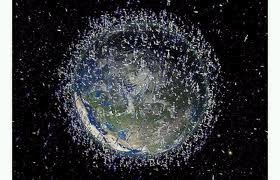
When the astronauts went to the moon, they left trash there. Very expensive trash. The amount of trash in space is becoming a problem. And with more satellites going up every year, the amount is growing quickly. It is estimated that there is nearly 2 million kilograms of space junk in low Earth orbit. Much of this is being tracked as it orbits the earth. There are about 10,000 objects that are about the size of a grapefruit or larger.
If a piece that large were to hit a satellite or space station, it could do some serious damage. If an object a centimeter or larger, moving at 40,000 kilometers an hour, were to hit something, it would be the equivalent of throwing a bowling ball at speeds of 500 kilometers an hour at a human being. The Space Shuttle has returned with large chips in its windshield (I don't think there are winds in space, but you know what I mean) that came from colliding with a speck. Impacts from space junk have been thought to disable two satellites.
So what can we do? Most of this junk will eventually fall to Earth. However, this can take a while, and it's a hazard to astronauts. There is a 1 in 91 chance that an astronaut could be hit with a piece big enough to penetrate their suit. The astronaut would be very lucky to survive. As if their jobs weren't already full of dangers.
Monday, March 5, 2012
Black Holes

Black holes are regions of space that have such massive gravitational pull that not even light can escape. No one has ever directly seen a black hole. There is thought to be one in the center of our galaxy, 40,000 times larger than the sun.
How is a black hole formed? There are many theories. The most common is that when a big star, about three times the size of the sun, reaches the end of its life, its stability cracks under its own gravity. The radius of the star shrinks and it starts to devour everything that's close enough. We cannot actually see a black hole. However, we can see the area of space affected by it. It is the event horizon, where there is no light. It is called a horizon because, like a horizon on our own planet, we cannot see beyond it.
If you enter an event horizon of a black hole, you will start to accelerate under the influence of gravity. You may start to orbit around the black hole, bumping into other pieces of matter. The jostling might throw you away from the black hole, or it might knock you into it. It won't go black as you go over the event horizon. You'll be able to see what's outside of the event horizon. The light everywhere will appear strange and distorted by the gravity.
If you look down, you'll see the singularity, which is a point where all physical laws have, basically, become indistinguishable from each other. At this point, you will begin to stretch and very quickly loose interest in what is going on around you. Fortunately, this should be fairly quick. Predictions about the inside of a black hole can be made, but it eventually gets too weird for science to describe. And a visit to a black hole is highly inadvisable.
How is a black hole formed? There are many theories. The most common is that when a big star, about three times the size of the sun, reaches the end of its life, its stability cracks under its own gravity. The radius of the star shrinks and it starts to devour everything that's close enough. We cannot actually see a black hole. However, we can see the area of space affected by it. It is the event horizon, where there is no light. It is called a horizon because, like a horizon on our own planet, we cannot see beyond it.
If you enter an event horizon of a black hole, you will start to accelerate under the influence of gravity. You may start to orbit around the black hole, bumping into other pieces of matter. The jostling might throw you away from the black hole, or it might knock you into it. It won't go black as you go over the event horizon. You'll be able to see what's outside of the event horizon. The light everywhere will appear strange and distorted by the gravity.
If you look down, you'll see the singularity, which is a point where all physical laws have, basically, become indistinguishable from each other. At this point, you will begin to stretch and very quickly loose interest in what is going on around you. Fortunately, this should be fairly quick. Predictions about the inside of a black hole can be made, but it eventually gets too weird for science to describe. And a visit to a black hole is highly inadvisable.
Labels:
black holes,
event horizon,
how is a black hole formed,
Space
Friday, December 18, 2009
Facts 4 the Day
Here's something for all you tea lovers to chew on,( or should I say sip on?)
Tea has a different taste when prepared with cold water instead of hot, due to the amount of oxygen in both. Also, if you add tea to milk, the flavor will be different
because a chemical in the milk called casein will break down less than if you add milk to tea.
If you don't like tea, here's something for you to think about. ( Let's hope you don't spend any sleepless nights pondering over it, wondering how much you actually know about your world. OK, maybe I'm exaggerating just a tiny bit. But just a little. I hope.)
There is a planet between Mars and Jupiter called Ceres. Actually, it's a dwarf planet. It used to just be considered an asteriod. And there's a planet after Pluto called Eris. Inside Neptune, it could also very possibly rain diamonds. I'm not making this up.
If you like these facts, come tomorrow. I'll post more if I can. Who knows, you might find out how to get an egg inside a bottle!
Tea has a different taste when prepared with cold water instead of hot, due to the amount of oxygen in both. Also, if you add tea to milk, the flavor will be different
because a chemical in the milk called casein will break down less than if you add milk to tea.
If you don't like tea, here's something for you to think about. ( Let's hope you don't spend any sleepless nights pondering over it, wondering how much you actually know about your world. OK, maybe I'm exaggerating just a tiny bit. But just a little. I hope.)
There is a planet between Mars and Jupiter called Ceres. Actually, it's a dwarf planet. It used to just be considered an asteriod. And there's a planet after Pluto called Eris. Inside Neptune, it could also very possibly rain diamonds. I'm not making this up.
If you like these facts, come tomorrow. I'll post more if I can. Who knows, you might find out how to get an egg inside a bottle!
Subscribe to:
Comments (Atom)